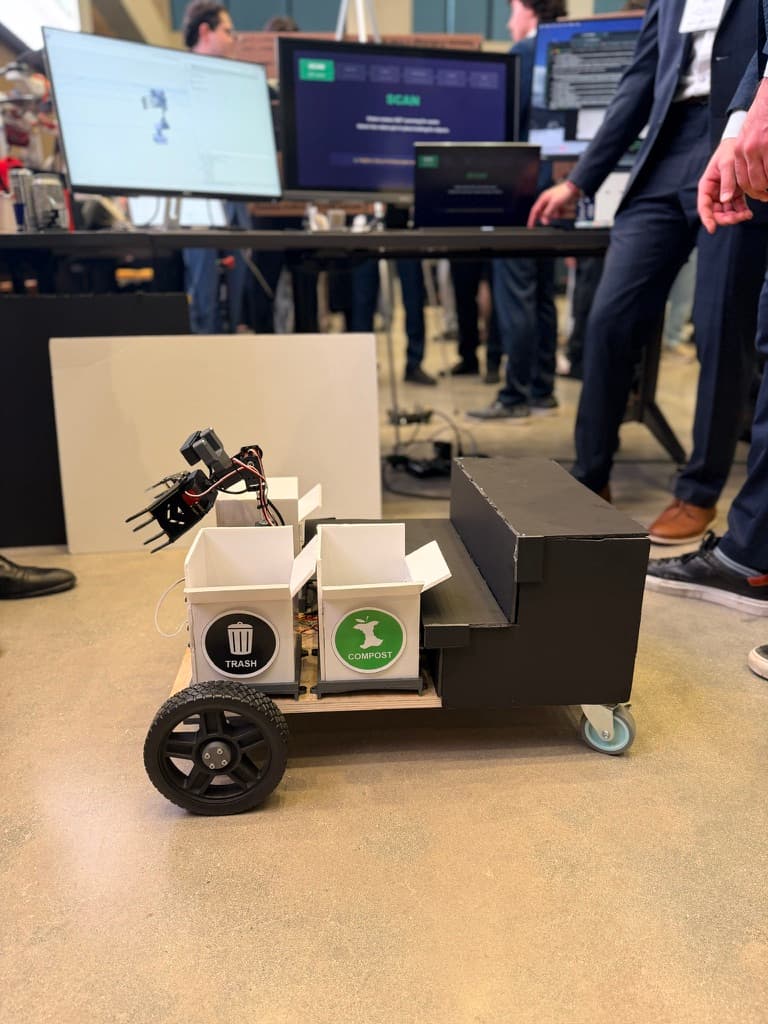
The RECLAIM prototype: an autonomous drive base, a 4-DOF sorting arm, and the recyclable / compost / landfill bins it sorts into.
Demo videos
Three pick-attempt runs on the physical prototype, captured during capstone testing and on the showcase floor (March 2026). Each exercises the full vision-servo loop: detect → approach → pick → sort. (The navigation re-benchmark further down this sheet is post-capstone, in simulation.)
REC ▸ Pickup 1: Tissue, then water bottle
Two-item autonomous run from capstone prototype testing, March 2026: landfill (tissue) → recyclable (water bottle), correctly classified and sorted.
REC ▸ Pickup 2: Aluminum can
Single-item run on a recyclable, March 2026: the scan → detect → drive → pick → sort loop on the physical prototype.
REC ▸ Pickup 3: Three-class sweep
Showcase-period run across all three waste streams: landfill (paper cup) → recyclable (aluminum can) → compost (half-eaten apple). Physical prototype, March 2026.
System architecture
Product design (specified, not built)
Autonomy loop
- SCANLiDAR + frontier exploration
- DETECTYOLO26n · 30 FPS
- DRIVEpure-pursuit nav
- PICK4-DOF arm
- SORT3 waste streams
The product integrates five subsystems on a differential-drive platform: 24V E-S planetary gearmotors for locomotion, a 6-DOF arm for pick-and-place, an OAK-D stereo camera with YOLO under TensorRT FP16 for detection across waste classes, a Livox Mid-360 3D LiDAR with SLAM Toolbox + a hybrid coverage algorithm for navigation, and an STM32F405 microcontroller for CAN-bus actuator control. The reduced-scope prototype used lower-cost substitutes, OAK-D Lite, a 4-DOF hobby-servo arm with a LewanSoul claw, YOLO26n (6 classes), Teensy 4.1, and a vision-servo state machine, with an RPLIDAR A1M8 on the prototype, but exercised the full scan→detect→drive→pick→sort loop.
The repository is a five-package ROS2 monorepo: reclaim_perception, reclaim_navigation, reclaim_control, reclaim_bringup, and reclaim_interfaces.
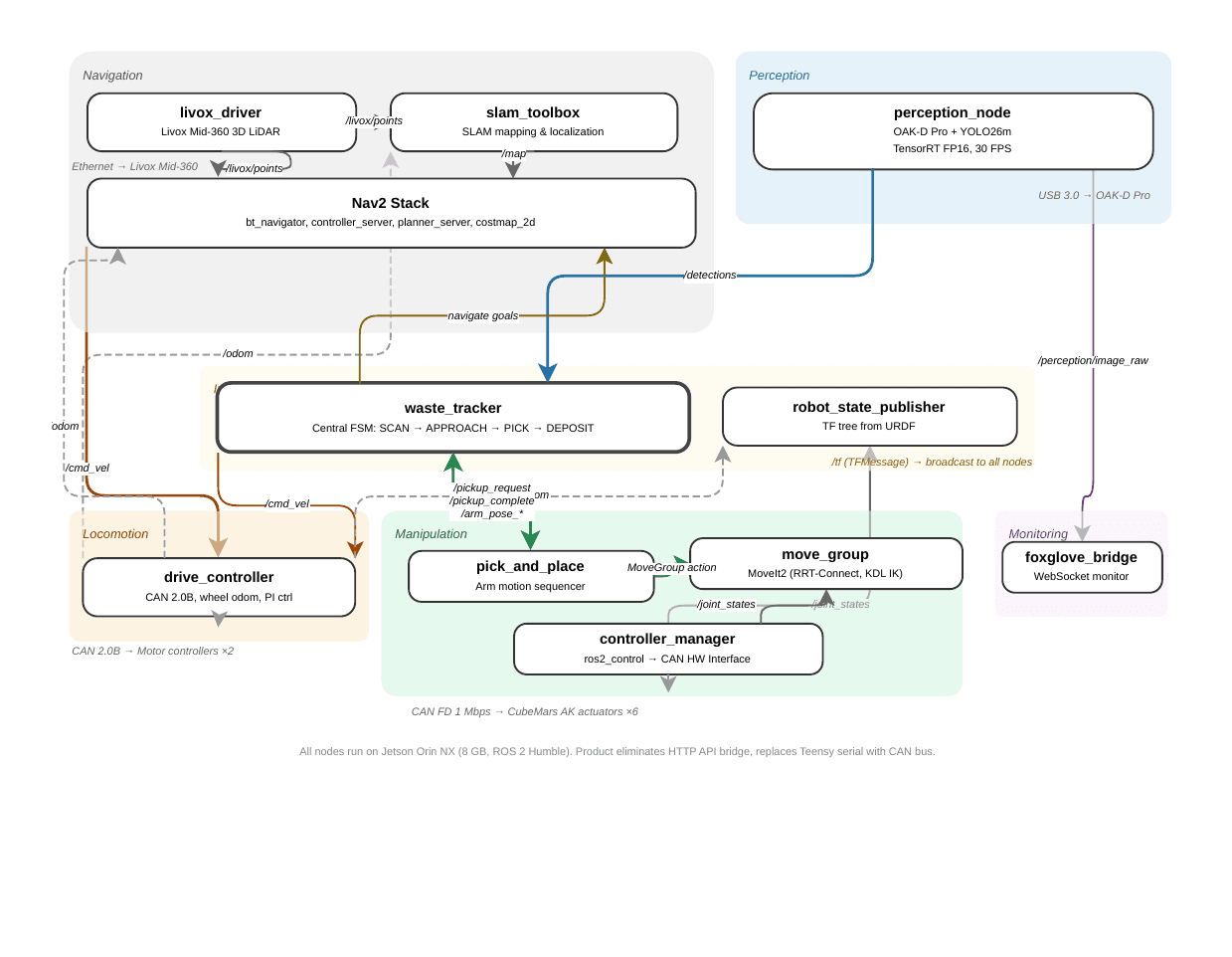
The product ROS2 node graph: every node and the topics wiring perception → planning → navigation → manipulation, all running on a Jetson Orin NX (ROS 2 Humble).
Hardware & electronics
Beyond the software, the product is a full electromechanical design: mechanical CAD, the microcontroller wiring I laid out, and its power distribution. I owned the perception + control electronics and the arm; the chassis CAD is the team's product concept.
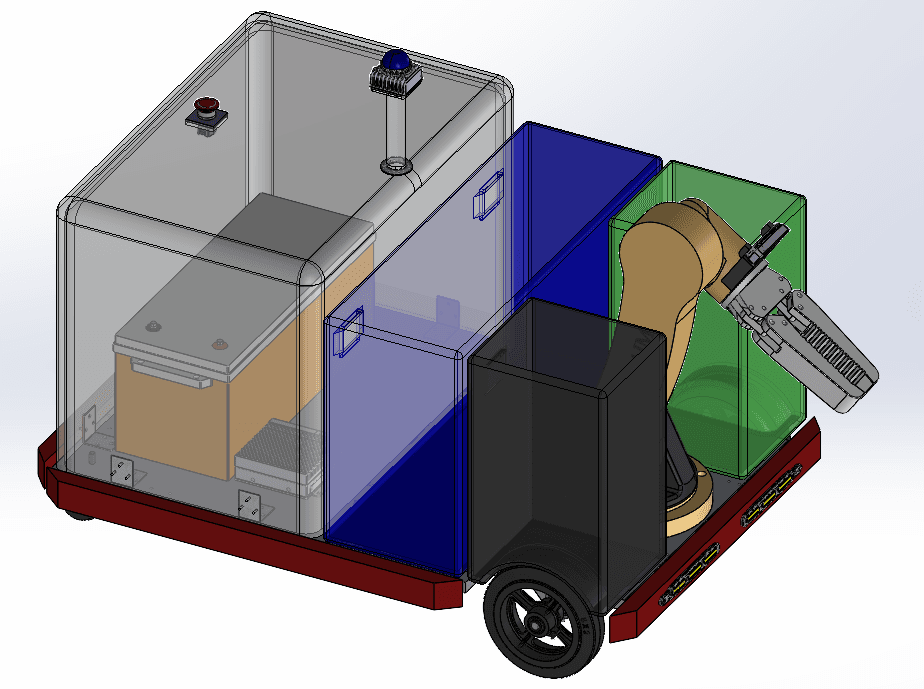
The product-concept CAD: a differential-drive chassis, three sort bins, an e-stop + status beacon, and the 6-DOF sorting arm I did the URDF + servo work for.
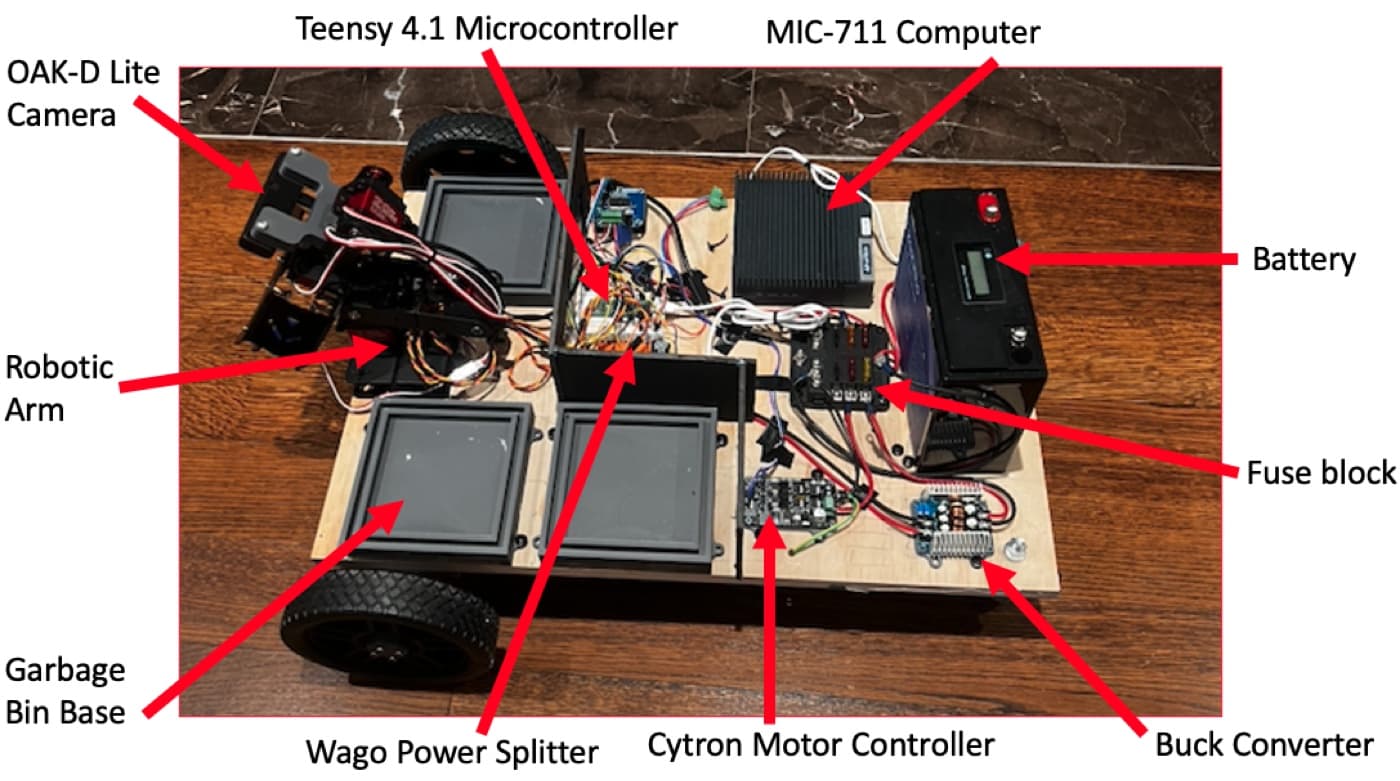
The prototype electronics, labeled: Teensy 4.1, MIC-711 compute, OAK-D Lite, the Cytron motor controller, battery, buck converter, fuse block, and Wago power splitter. I owned the Teensy firmware and the actuator/encoder wiring.
Problem
Post-event cleanup at indoor venues is an operations problem before it is an environmental one. The United States produces 292.4 million tonnes of municipal solid waste a year and recycles only 32% of it, and U.S. schools alone generate 530,000 tonnes of cafeteria waste annually. Contamination rates of 25–30% in recycling streams cost the U.S. recycling industry an estimated $3.5–4 billion a year in rejected loads and reprocessing, and most of that contamination is human sorting error at the bin.
The people who do this work are getting harder to find and harder to keep. Around 80% of commercial cleaning companies report they cannot staff adequately, annual turnover in custodial roles runs over 75%, and custodial work ranks as the fourth-deadliest occupation in the United States, with repetitive bending, lifting, and waste transport driving documented musculoskeletal injury risk.
Existing automation addresses these problems in isolation. Floor scrubbers clear fine debris but have no end effector for picking up discrete objects, and stationary sorters like AMP Robotics' Cortex reach high accuracy on a conveyor line but need fixed infrastructure and a waste stream someone has already collected. No commercially available platform integrates autonomous navigation, object-level detection, physical pickup, and multi-stream sorting on a single mobile base. RECLAIM is built for the open floor of conference halls, banquet rooms, gyms, cafeterias, and expo floors, the same five venue types its navigation stack is benchmarked on.
My role
Four-person capstone team (Abdul Kassem, Issa Ahmed, Dev Panara, Shady Siam). As team lead I had a hand in every part of the build, and the subsystem I owned end-to-end was perception and control. That meant the Jetson Orin NX onboard computer and every Python ROS2 node running on it, the Teensy 4.1 firmware plus the pinout and wiring for actuators and encoders, the computer-vision model design and its TensorRT export pipeline, and the URDF robot model and servo work for the 4-DOF prototype arm.
Approach: perception
YOLO26n trained on a combination of Roboflow + Kaggle waste datasets, refined across three training cycles (v3, v5, v6) using confusion-matrix-driven class elimination to cut the class set from 11 to 6 and drop ambiguous categories. mAP50 improved from 0.693 to 0.826 across those cycles. Exported under TensorRT FP16 to hit 30 FPS on the Jetson Orin NX, sufficient to drive a vision-servo control loop without dropping frames.
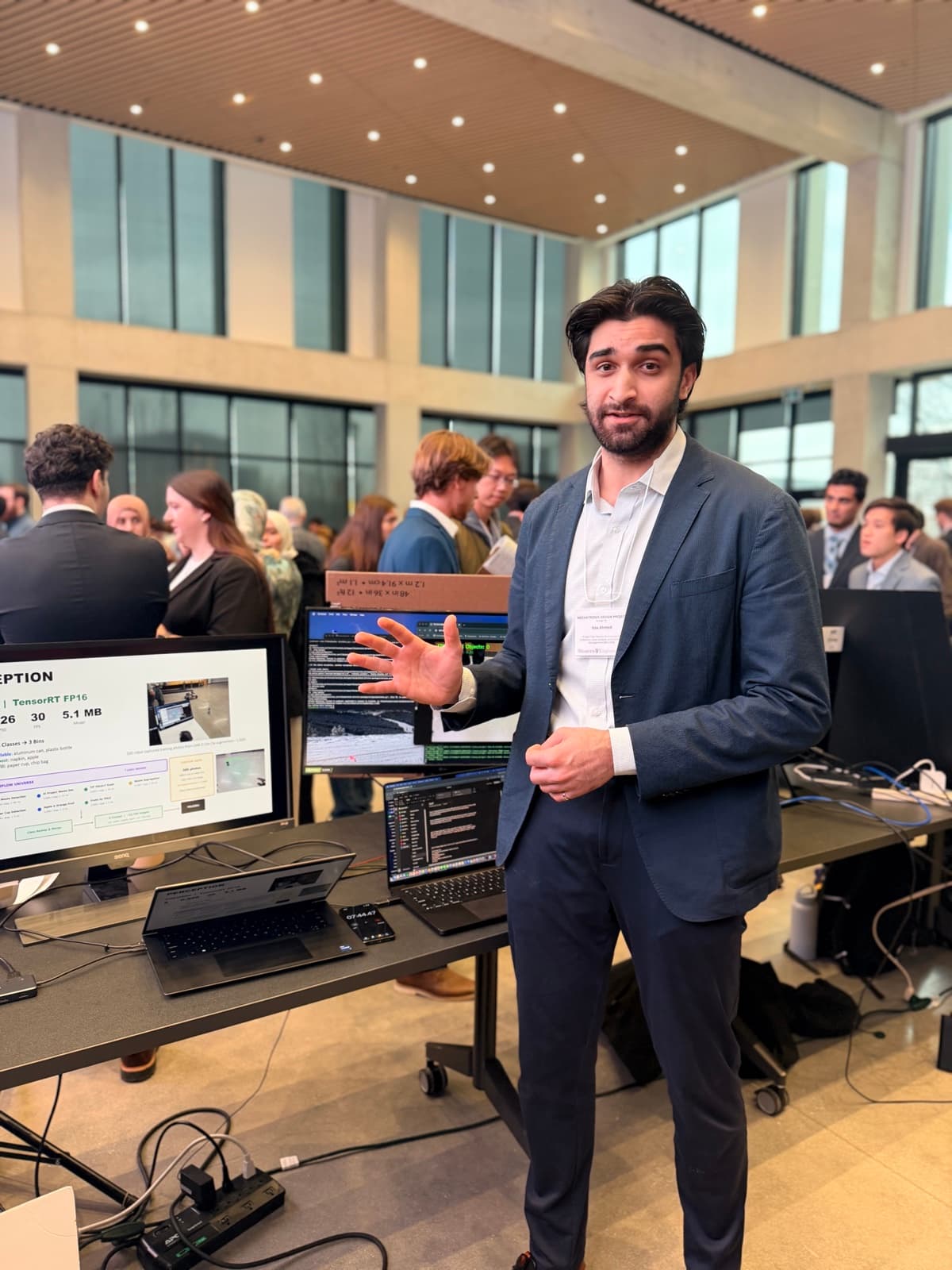
Demoing the perception stack at the showcase: the monitors show the TensorRT-FP16 detector at 30 FPS, its 5.1 MB model, and the class-to-bin mapping.
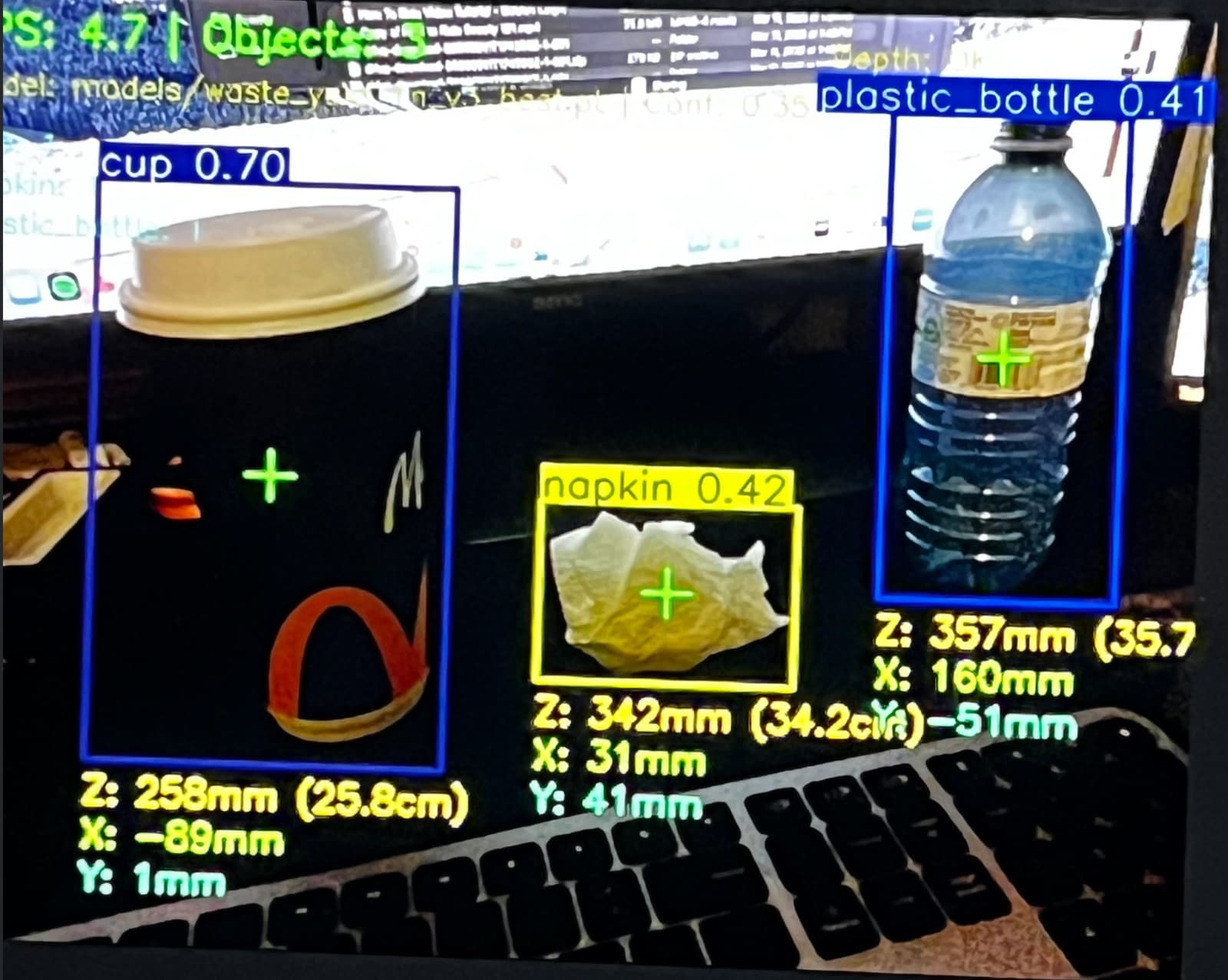
The detector running live: each waste item gets a YOLO class + confidence and a 3D position (X/Y/Z in mm) fused from the OAK-D depth camera (what the arm uses to reach for it).
Approach: navigation (rebuilt post-capstone)
The capstone shipped a robot, and a navigation benchmark I stopped trusting. The original simulator assumed an idealized 0.5 m/s robot with continuous motion, and its numbers made it into the final report. After the March showcase I rebuilt the simulator from scratch (reclaim_v2, June 2026), calibrated to the real robot's measured specs: 0.3 m/s max linear velocity, 1.0 rad/s angular, 0.3 m/s² acceleration, 0.470 m wheel separation, the OAK-D's 73° FOV and 0.4–3.0 m detection range, and the ~13 s/item stop-look-drive approach cadence from the real waste_tracker_v2.py pipeline, then re-benchmarked every algorithm on it. Every navigation number on this page comes from that re-baseline.
reclaim_v2 is an event-driven executive over four behaviors (SCAN, COLLECT, SWEEP, DUMP) arbitrated by priority:
Nav executive
- SCANfrontier exploration items detected
- COLLECTroute + pick items coverage ≥ 99%
- SWEEPclose coverage gaps buffer full / final
- DUMPempty the bin
Event ladder
- item picked → re-decide
- scan finished → COLLECT
- path blocked ×3 → requeue · ×6 → abandon
- buffer full → DUMP → resume
- Commits, doesn't thrash. The executive re-decides only on events (item picked, scan finished, path blocked) never per-tick, so target switches happen at plan boundaries instead of oscillating between goals.
- SCAN: frontier exploration. Scan viewpoints sit on the seen side of the fog boundary, scored by unseen cells revealed per unit of travel-plus-scan time, with a directed pivot scan on arrival (0.25 rad/s around the left wheel, like the real robot).
- COLLECT: exact routing where it's affordable. Batches of ≤7 items are routed exactly (Held-Karp) over true A* path distances; larger batches use nearest-neighbor + 2-opt. Dump-station stops are inserted at the tour boundary that adds the least detour, computed in closed form from an init-time Dijkstra field.
- Motion + recovery. Pure-pursuit driving with acceleration limits matching the real drivetrain, plus a watchdog recovery ladder: 3 consecutive A* failures requeues the item, 6 abandons and logs it, so one unreachable item can never hang a mission.
The simulator runs entirely client-side: React + Three.js (R3F), with a headless Node harness that regenerates the benchmark matrix from a single command. Every run is reproducible byte-for-byte from its (preset · seed) chip, shown in the UI. To try it live, pick a venue and seed, watch the planned route, behavior timeline, and live detection captions, and pit v2 against the four baselines on the comparison dashboard, interactive 3D demo ↗.
Results: the re-benchmarked navigation stack
Re-benchmarked across 5 venue presets × 3 seeds (15 missions per algorithm), v2 completed every venue, from conference (30 items; seed 7: 1030.6 s, 130.3 m) to expo (70 items; seed 42: 3142 s, 508.4 m, 5 dump trips):
| Algorithm | Missions complete | Items collected | Notes |
|---|---|---|---|
| RECLAIM v2 | 15/15 | 867/870 | 99.0–100% verified coverage every run; 3 items declared unviewable, logged |
| Info-gain explorer | 12/15 | 820/870 | stalls out; leaves 3–10 items per run |
| Nearest-neighbor | 10/15 | 846/870 | avg 655.1 m driven vs v2's 299.4 m |
| Full boustrophedon | 6/15 | 810/870 | rigid stripes fail in complex venues |
| RECLAIM v1 (showcase algorithm) | 6/15 | 808/870 | self-declares done prematurely at ~95% fog |
NOTE: Flagship run: cafeteria, 80 items, seed 42
NOTE: Why items per minute is the wrong headline
Approach: manipulation
The product arm is a 6-DOF CubeMars BLDC arm with a Robotis parallel gripper driven by MoveIt2 motion planning. MATLAB inverse-dynamics confirmed adequate torque margins across all arm joints with a 500 g payload, and a computed torque controller achieved near-zero tracking error across pick-and-place trajectories. The prototype substituted a 4-DOF hobby-servo arm with PI joint control and a PI tracking controller for vision-servo approach behaviour.
Live demo (March 26, 2026)
The prototype was demonstrated live, completing fully autonomous scan→detect→drive→pick→sort cycles across all six waste classes with no manual intervention. The cohort awarded the project 3rd place overall, and 1st in the AI division.
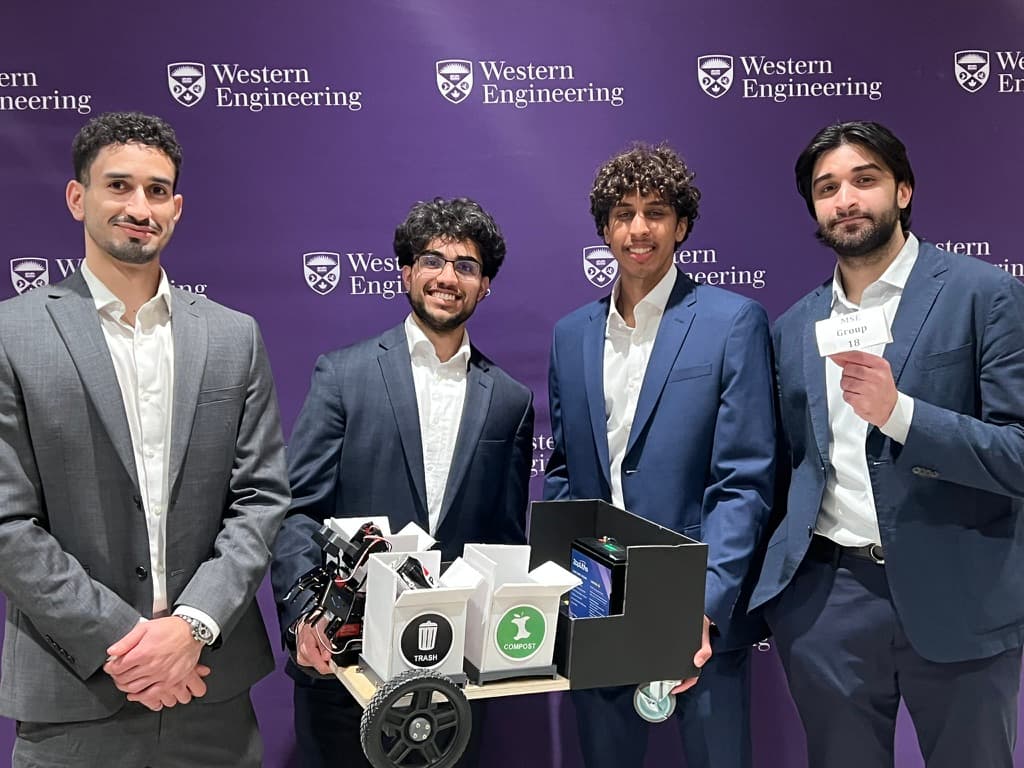
Team RECLAIM with the prototype at the MSE 4499 showcase (March 26, 2026): 3rd place overall, and 1st in the AI division.
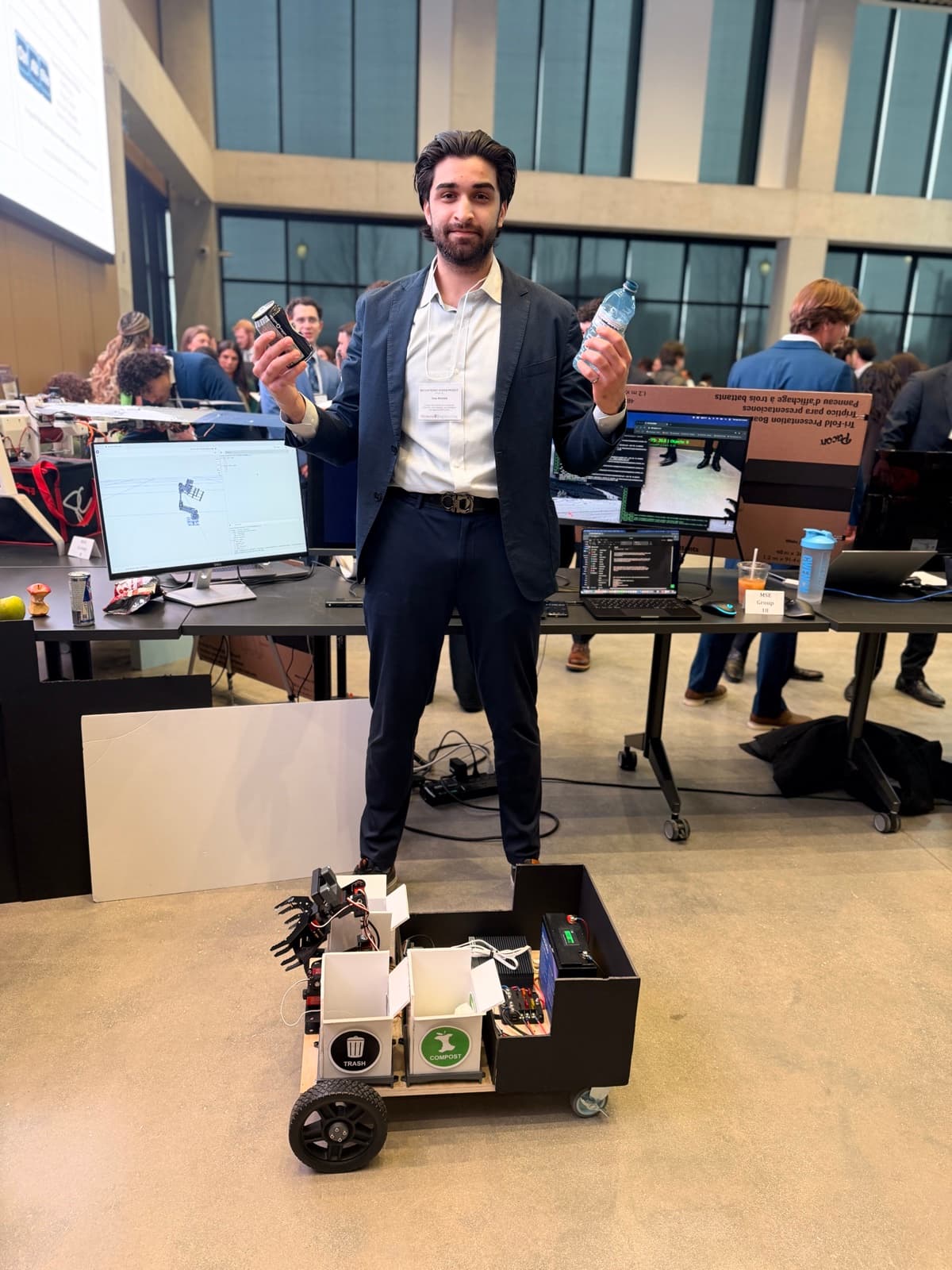
At the showcase with the prototype and two of the items it sorts: an aluminum can and a plastic bottle, both recyclables.
Tech stack
Languages
- Python
- C / micro-ROS
ML & Vision
- PyTorch
- OpenCV
- YOLO26n
- TensorRT FP16
- Roboflow
Robotics & Sim
- ROS2 Humble
- Nav2
- SLAM Toolbox
- MoveIt2
- Foxglove Studio
- Three.js (R3F)
Hardware & CAD
- Jetson Orin NX
- OAK-D Lite
- RPLIDAR A1M8
- Teensy 4.1
- SolidWorks
- MATLAB
Reflection
The tightest engineering constraint was the gap between the product spec and what we could realistically build in 8 months on an undergraduate budget. The response was to scope two layers: a fully specified product (CubeMars BLDC arm, OAK-D Pro, Livox Mid-360 LiDAR, STM32F405 + CAN, 27+ waste classes, MoveIt2 + Nav2) and a reduced-scope prototype that exercised the same control loop with hobby-grade components. That separation forced honest reasoning about what we were validating with each subsystem and is what carried us through the live demo without manual intervention.